The Commonwealth Games: From Empire Roots to Ugandan Glory in Glasgow 2026
By: Sserwanga Kizito Najib/ Sunday, 2nd August 2026
The Origin of the Commonwealth Games
The Commonwealth Games began as the “British Empire Games” in 1930 in Hamilton, Canada. The idea came from Canadian journalist Melville Marks Robinson, who wanted the nations of the British Empire to compete in friendship through sport. After World War II the name changed to the “British Empire and Commonwealth Games”, and in 1978 it became the “Commonwealth Games” as we know today.
74 nations and territories that make up the Commonwealth of Nations come together every 4 years to compete, not just in athletics and boxing, but in values of “Humanity, Equality and Destiny.” Unlike the Olympics, the Games have no opening ceremony military parade and no national anthems on the podium until 2022. It’s about shared history turned into shared competition.
From 1930 to now, the Games have grown from 11 nations to over 3,000 athletes competing in sports like netball, para powerlifting, 3×3 basketball, and swimming. Glasgow 2026, is billed as “the most inclusive Commonwealth Games in history”, for the first time the very first medal will be awarded in a para-sport event for people with physical handicaps.
Uganda and the Commonwealth Games: A 70-Year Story
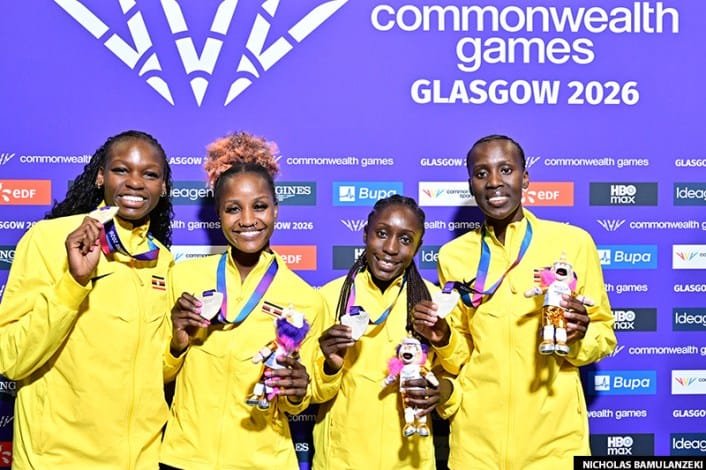
Uganda made its debut in 1954 in Vancouver and has competed in every edition since, except one. Over seven decades, Uganda has built a proud record: 58 medals total: 19 gold, 16 silver, 23 bronze ranked 18th all-time.
That legacy is dominated by two sports: athletics and boxing. Uganda became famous for long-distance dominance, winning the men’s 10,000m title at five consecutive Commonwealth Games and many popular Ugandan runners have made a mark on these games.
The 2026 Games in Glasgow, Scotland, mark Uganda’s 17th appearance. This year Uganda sent a team of 55 athletes in 9 sports: Athletics, 3×3 Basketball, Boxing, Track Cycling, Netball, Swimming, Para Swimming, Judo, and Para Powerlifting. The team is notably gender-balanced: 35 women and 20 men.
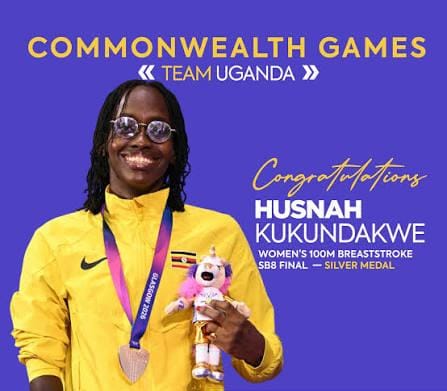
Flag bearers leading the way include Mary Cholhok Nuba of the She Cranes netball team and Dennis Mbaziira, Uganda’s first para-powerlifter. Uganda opened its account early. Husnah Kukundakwe delivered Uganda’s first medal: a historic silver in para swimming on July 28. That puts Uganda on the medal table with 0 Gold, 1 Silver, 0 Bronze.
Other moments to commend:
1. The She Cranes: Ranked 6th in the world, they started with a convincing win over Wales and followed it with a record-shattering rout of Trinidad and Tobago. Netball continues to put Uganda on the global stage.
2. Boxing: Bombers captain Nuhu Batte marched into the quarterfinals, while heavyweight Aziz Abdul said he’s determined to chase a medal.
3. Para-sport breakthrough: Beyond Kukundakwe’s silver, the inclusion of para powerlifting and para swimming shows Uganda’s commitment to “no talent left behind”. Denis Mbaziira and Husnah Kukundakwe were specifically highlighted as part of a rising generation driving visibility in inclusive sport.
Building on Birmingham 2022
Uganda went to Birmingham with big expectations and delivered: 5 medals, 3 gold, 2 bronze. Jacob Kiplimo won double gold in 5,000m and 10,000m. Victor Kiplangat made history with Uganda’s first marathon gold. Peruth Chemutai took bronze in steeplechase and Teddy Nakimuli in boxing.
Glasgow is a different challenge, the program is smaller and the marathon was omitted, but the hunger remains, backed by increased government funding.
Beyond the Medals, Ugandan Leadership in 2026 is also historic off the field. In November 2025, Dr Donald Rukare became the first African President of Commonwealth Sport, the body that governs the Games. As Dr Rukare said, sport in Uganda “unites communities, inspires ambition, and empowers the next generation, particularly girls and women”.
From Hamilton 1930 to Glasgow 2026, the Commonwealth Games have evolved from an empire showcase to a festival of unity. For Uganda, they have been a stage where distance runners, boxers, netballers, and now para-athletes tell the Ugandan story of resilience.
In Glasgow, even with a smaller team and tougher competition, Uganda is again proving its place: winning medals, breaking records in the pool, dominating on the netball court, and leading the Commonwealth movement itself.
The journey that started in 1954 continues. And as the “More in Common” campaign launched in Kampala put it: this is about celebrating Ugandan excellence and the values that bind 74 nations together.
Go Team Uganda
Story by: Sserwanga Kizito Najib (nazl4e@gmail.com)